 Another voice has been added to the hue and cry for a minimum price for alcohol. Within days of Rubber Duck stepping down from his CMO post, the better to quack his favourite message, NICE, the National Institute for Health, Clinical and Anything Else Anybody Will Pay Us For Excellence, has jumped on the wagon. Voluminous guidance, published earlier this week, recommends a raft of measures that, NICE says, will ‘significantly decrease alcohol consumption’ if implemented. A top tip for government is to make alcohol ‘less affordable by introducing a minimum price per unit’. There was much talk of growing tides of unassailable evidence. Dr No began to fear he was now King Canute, alone on the beach, his once half full glass now half empty. Until, that is, he heard an interview on the Today programme. Suddenly the glass was half full again.
A Professor Mike Kelly, Chief Pongo of Public Health at NICE, and the man responsible for the report, was being interviewed by Wingnut. Wingnut was his usual Tiggerish self; the Prof was smooth, suave and very authoritative. “The evidence that we’ve reviewed, from across the world, indicates that minimum pricing is just about the most effective way of targeting problems drinkers” he assured us in a voice smoother than a thousand year old Malt. A distant tap-tap-tap echoed nails being hammered into white cider coffins.
Unfortunately for Mike, the BBC had also invited along a Gavin Partington, spokesperson for the Wine & Spirit Trade Association. Gavin showed himself from the off to be a high proof, spirited spokesperson. In double quick time, he was pulling the beer mats from under the Prof’s glass of fizzy water. There was, he said, no international evidence on minimum pricing, for the singularly persuasive reason that no country had introduced true minimum pricing. The Prof’s glass of fizzy water started to go flat. Challenged by Wingnut about the lack of evidence, the Prof let the cat out of the bag. The recommendation, it turned out, wasn’t based on international evidence after all, but on something quite quite different, something known as economic modelling.
Wingnut is in fact an economic super-computer cunningly disguised by the BBC to look and sound human. Economic modelling is the bread and butter, or rather the software, that makes him tick, and so, naturally enough, economic modelling was just fine for Wingnut. But Dr No is not an economic super-computer. Dr No, trapped in his non-economic, non-super-computer world, draws a distinction between evidence, derived as it is from verifiable real world data, where conclusions are properly bound to and by the original data, and modelling, economic or otherwise, which – all said and done – is nothing more or less than a clutch of souped-up Excel ‘what-if’ spreadsheets, where any number of internal assumptions may be made; and where what comes out depends on what goes in. Assumptions, of course, have form when it comes to cock-ups; and, as always, GIGO applies.
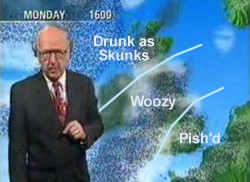
The difference, we might say, between NICE’s ‘evidence’, and real evidence, is between yesterday’s known weather and tomorrow’s forecast weather. Yesterday’s weather we know, because we saw it; tomorrow’s weather, even with the most sophisticated meteorological modelling, remains a forecast. It might – or might not – happen. We just don’t know – until tomorrow, when fact replaces forecast.
Dr No has nothing against forecasts. He makes regular use of any number of forecasts. But he never forgets that they are forecasts, not facts; and so Dr No does not take kindly to NICE pedalling forecasts as facts. He considers it at best disingenuous. Luckily he is not alone. One high profile researcher from ScHARR (the Sheffield outfit that did much of the research), a Dr Petra Meier, was recently called to give evidence to the Scottish Parliament – Scotland is set to be the guinea-pig in the minimum pricing trial – on the nature of ‘Econometric modelling as a decision-making tool’. Dr Meier was keen to put things into perspective. The model, she said, was a prediction, rather than a post-hoc observation; it was, she said, ‘like the weather forecast’.
Quite what the academic forecast now is for Dr Meier remains to be seen. But she is to congratulated for speaking plainly and clearly on the distinction between facts and forecasts. NICE, on the other hand, have jumped on the minimum pricing wagon, and presented a recommendation based not on facts, but on forecasts.
Barbeque summer, anyone?
I have yet to meet a smoker who cuts down or ceases after budget day. They might talk about it but don’t actually do it.
I think I am even less likely to meet a problem drinker who will cut down or cease drinking if a minimum price comes into force. The price hike will be off-set somewhere else.
NuLabour very kindly gave the problem drinker more opportunity to follow their passion after extending opening hours. The extra money appears to have been found to fund this habit by our drinking buddies. Cheers!…….Hic!
Nikita – you have hit on the question this post begs: what will actually happen in the real world (as opposed to the modelling world)? NICE claims minimum pricing targets problem drinkers, yet spares the sensible drinker (a raw nerve for politicians). In fact NICE has even been so helpful as to guesstimate that the sensible drinker will take an annual hit of £12, while the problem drinker will take a massive £160+ hit (because they drink more booze/more cheap booze).
As you rightly point out, most problem drinkers have a problem (they wouldn’t be problem drinkers otherwise), and will seek to maintain their intake. So – given a fixed pot of money, they will find the extra £160 – some 50p a day – from another budget. Since food and booze shopping is often done together, it is likely the extra 50p a day/£160 a year will come out of their food budget. End result: no change in alcohol consumption, diet impaired by 50p a day/£160+ a year. NICE’s recommendation , far from ‘helping’ problem drinkers, is more likely to aggravate their position.
The other big question is whether this is any of NICE’s business anyway. They started off life as the National Institute of Clinical Excellence. Now it seems they can make recommendations to government on matters which are more a matter of social policy than clinical excellence. Given the cosy funding arrangements, is it any surprise that NICE comes up with what the government would like to hear?
Dr No is not for a moment suggesting that government goes to the poodles in its kennels and says ‘here are the results, now do the research’. Instead, in a subtler way, the logic of ‘he who pays the piper’ wends its way through the system. A whispered ‘Remember what happened to Professor Nutt…’ is more than enough.
‘Big’ names like the CMO, the RCP and NICE also no doubt rely on eminence bias (believing something is true because someone eminent said it was true). The great majority of the media, to their everlasting shame, are particularly prone to ignoring this bias. But, as Dr No has shown in previous posts as well as here, when you drill down and look at the evidence behind the claims, the eminence quickly fades into smoke and mirrors.
Note – for the record – DN does not work for the booze industry; nor does he deny that alcohol is a serious problem. What he does object to is using shoddy science to beat the prohibitionist drum, because (a) it prostitutes science and (b) because it is not proper science, it stands a very high chance of being just plain wrong (and so a waste of time and money), or worse (positively harmful eg through unintended consequences).
I think the problem is that those who are likely to be dissuaded from drinking by lower prices are those who put finances before alcohol consumption, something most alcoholics I would hazard a guess, do not. What it means is that for problem alcoholics who are not functioning well in society and on low incomes will devote an even higher percentage of their monthly intake on booze, thus reducing there ability to look after their mental and physical well being. I also now see I have been pipped to the post making this relatively simple observation:( I do not know if it means I have a vested interest, but I sit here drinking a can of guinness from one of the six crates during the recent three for £20 at Tescos. Perhaps an apartheid situation with much higher taxes might be appropriate. Certain drinks are far more alcoholic friendly, I personally see the 10, 11 and 12% abv ciders to have just one purpose.
Nikita & M (and anyone else who is interested) – Dr No reckons opportunity costs and price elasticities are sufficient to warrant a post of their own – see NICE but dim