 Dr No’s NHS dentist is a likeable old cove. Asked how he proposed to fix Dr No’s new crown in place, he announced ‘Bostik Number Five’ – a Dr No response if ever there was one. So – just to be clear – this post is not about knocking dentists as a profession. What it is about is looking at what happens when you run a substantial private mostly insurance based system alongside a publicly funded NHS one; and what has happened in dentistry does not bode well for the rest of the NHS.
On Monday, Channel Four’s Dispatches programme invited dentists to open wide. A number obliged, and an unedifying collection of drill sharks, cement mixers and card snitchers sprung into view. The general wheeze was to get you, an NHS patient, in the chair, and then offer a Hobson’s choice of private treatment, at which point wallets, inevitably, opened wider than mouths.
And where dentistry has gone – as indeed, in its own way, has higher education – the rest of the NHS could so easily go under the Lansley reforms. Consider GPs, for example. Much has been said about their proposed commissioning role, but we should not forget that first and foremost, GPs are providers, providers, as it happens, who, operating under the ‘independent contractor status’ system, are small private business providers who are in effect obliged, under the current system, to contract with the NHS to provide NHS medical services to NHS patients, but who nonetheless remain, all said and done, and under the skin, small private businesses.
Once Lansley’s Big Bang has hit the NHS, with its allowance for ‘any willing/qualified provider’, there will be no bar – if anything, there will be encouragement – to GPs forming themselves up into private provider federations; indeed, the Royal College of general Practitioners has already smelt the money, and have helpfully provided a ‘toolkit’ for practices keen to tool up in the federated way.
Naturally enough, this is all being done under a banner of better services. “We believe that Federations, as providers of services, can work well alongside Consortia, and that there are considerable opportunities for Federations to maximise benefits for patients” says Professor Steve Field, in his Foreword to the Toolkit. Too right they can ‘work well alongside Consortia’. What he doesn’t add, but we might, is that it will also offer considerable opportunities for Federations to maximise profits for partners.
So far, so so, one might say, since all the money sloshing around is still NHS money: the services provided are still being paid for out of public funds, as willed by the current, and all previous, NHS Acts, under the Secretary of State’s duty to provide a free at the point of delivery comprehensive health service. But once that duty is removed, as the proposed Health and Social Care Bill will do, and GP consortia are up and running, infiltrated and assisted by American and American style health insurance providers, it can only be a matter of time before some bright spark says:
‘Hey guys – why don’t we do for medical services what dentists have already done for dental services? Haul the punters in on NHS terms – and then offer them a Hobson’s choice of private, insurance based care? Who in their right mind is going to risk that run-down grubby NHS hospital when over road we can offer our shiny new Federated clinic – all yours for less than the daily cost of a packet of gaspers?’
Nor does it matter one jot what the Tories intend for the NHS. They can profess love and devotion to the NHS and its principles, and that it is safe in their hands, until the cows come home. The inescapable fact is that, whatever their intentions, the proposed reforms will create a system in which a parallel private insurance based system is not only possible, but, in a market-based profit-motivated system, inevitable.
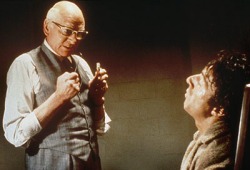
In Schlesinger’s film Marathon Man, Olivier’s character dentist Dr Christian Szell repeatedly asks Dustin Hoffman: ‘Is it safe?’ Central to the film is the fact that Hoffman has no idea what ‘it’ is; but were ‘it’ to be the NHS under the Tories’ proposed reforms, then the answer could only be a resounding ‘no’.
I see the way you are thinking – but i dont think Federations would allow GPs to pocket money
My sense of them is that they pull in other providers – from other sectors and together create the integrated services that meet the needs of their patients at local level. I am not imaging Federations to be Chambers – more like Community based integrated care organizations. I think that even without the changes in the NHS this would be the direction of travel.
I dont think GPs are in it for the money – i think, and remember i have a COI in this, that we are in it to make a difference for our patients. Clearly we cant do this at a loss
All best
Love your blogs
Clare
If anything is guaranteed to make My Black Cat arch her back, it is the word “toolkit” used outside the context of joinery and plumbing.
If anything is guaranteed to make My Black Cat spit, it is the new breed of “Botox Dentists.”
“Botox Dentists” are presumably in it for the money, although no doubt they will argue it is just an extension of cosmetic dentistry. That doesn’t wash with My Black Cat. The question is whether “Botox GP’s” would come out of the woodwork and infest professionalism given certain circumstances.
Clare – Dr No suspects from your public utterances that your heart and mind are in the right place, but he cannot agree that federations are always going to be some sort of altruistic network of worthy souls doing the best for their patients. Some will be, of course, but general practice is a broad church, and while the worthy souls sit at one end of that broad bell shaped curve, there are just as many (assuming an unskewed Normal distribution of course!) sharks and graspers at the other end. Indeed, our friends at The Daily Mail regularly report on them.
The RCGP’s Federation ‘Toolkit’ (Dr No shares the WD’s Black Cat’s abhorrence of toolkits outside the trades) is quite open (eg pages 80 and 92) about the fact that in some cases the federations will be about making money for partners and/or shareholders – ie private profit, and even gives an example (Leodis – page 21), where one arm of a ‘federation’ is a private company limited by shares (the bog standard legal entity for making money) set up to provide services, while somewhat brazenly another arm of the federation is an LLP set up to commission services (from whom, some will inevitably wonder), while the third arm is something of a ‘dark horse’ – a ‘joint venture company’. Leodis’s (interestingly they don’t appear to present themselves as a federation) own website is here.
Dr No has probably completely lost the plot – but it does seem to him from what he has read on their website that Leodis is at least partly about trousering NHS money for private profit. And yes of course that is what GPs (and independent contractors) have always done (and yes they have every right to earn an income), but outfits like Leodis are taking it on to a new previously unimagined scale. Dr No can’t help wondering if some will see Leodis as a barn-door example of GPs setting up jobs for the boys, and in so doing, gaming the system…
PS Glad you like Dr No’s work – although you probably wont after he posts this comment!
“PS Glad you like Dr No’s work – although you probably wont after he posts this comment!”
You have put forward a fair point of view Dr No, exactly what Dr Claire Gerada is here for to find out what other Drs think and learn from it. Good for her she’s doing that too, it’s what I call good leadership.
Welcome to the blogosphere Dr Gerada, you like Dr No’s blog and we like you visiting … and participating too, so please keep it up 🙂
Dear Dr No
Just because we disagree does not mean that I don’t respect your views
I too dislike the word Tool-Kit
I also dislike the words:
Care-pathway [patients do not follow care pathway]:
High quality [as if we should be delivering low quality]:
Comprehensive {where what they mean by comprehensive is not defined];
holistic;
Upstream and down stream [they should refer to rivers not to services etc]
I am even getting to dislike the word Integrated as i worry its going to mean something bad for general practice
All best
Clare – Dr No wouldn’t be that surprised if there was considerable overlap between your views and his. And like Sam, he has been impressed by your willingness to get involved, to lead from the front, and talk to the rank and file. You also have a good eye for dodgy words!
We witches have problems with almost all the current jargon being used in medicine. We wonder how many committees sit, how many hours are spent and how much of tax payers money contributes to the birth of each new piece of jargon that is introduced into medico-political-management vocabulary.
However, there is one important and meaningful pathway that has degenerated into weed-infested crazy paving littered with potholes and hidden under tenacious brambles and stinging nettles.
What path could this be?
It is the pathway that allows a GP to write a confidential letter about a patient to a particular hospital consultant without it being intersected by Tom, Dick, and Harriet on a referral committee.
Tom, Dick and Harriet are necessary prerequisites for the type of privatisation that will result from the reforms i.e the type of privatisation that uses taxpayers’ money.
GP’s and consultants should never have allowed this pathway to degenerate and they should set about right now with their scythes, shears, spades and forks and whatever else it takes to reinstate it immediately.
It seems they are now coming out of the woodwork….
http://www.spinwatch.org/blogs-mainmenu-29/tamasin-cave-mainmenu-107/5424-outing-the-nhs-reformers