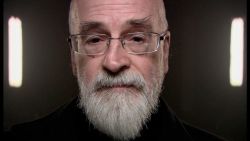
 Last night, the Incredible Dement shocked the nation. Appearing on BBC2, armed with only a Euro-Rover ticket and a large hat, he toured the Continent, boldly seeking out destinations where others fear to tread. Everywhere he went, it was either raining or snowing, for these were the lands that God forgot. Soon it became apparent that, when the ID was on the road, all roads led, not to sun and the Eternal City, but to snow, and an another altogether different type of Eternity. They led to Zurich, to a dapper blue house tucked away on an industrial estate – a planning requirement, you understand – where a Mr Peter Smedley, late of the canning concern, was about to do to himself what his family had spent decades doing to peas. The only difference was that Smedley would emerge not in a can, but an urn. He had come to Dignitas, to die.
Outside, it was snowing. Mr Smedley approached his canning experience with a light Scott of the Antarctic touch. One expected him at any moment to say that he was just going outside, and might be some time. But it was not to be that way. In the cold light of the camera, Smedley downed his canning draught. Outside, it continued to snow. Inside, he exchanged light but tender words of comfort with his wife. Then he coughed, groaned, called for water, groaned again, cleared his throat, snorted, snored, and died. Just like that. The ID announced ‘a result’, and even had a good word for the snow, it being the ‘right kind’ of snow, before declaring Smedley a hero, the bravest man he had ever met. That is as may be. Certainly, Smedley showed courage and fortitude. But in Dr No’s eyes, the real hero, or rather heroine, was the Lady from Rhodesia, Smedley’s wife. It was her courage, her fortitude, and her dignity that was outstanding, so much so that it made the hardened Dr No want to weep.
Now, this programme was well made, even if it was barely one stop short of an advertorial for Dignitas and, more generally, assisted suicide. Many column inches have already been written about it, and no doubt many more have yet to come, focusing on the merits or otherwise of broadcasting footage of real death (Dr No is of the view that it was right to air it), and on the neo-sacred right to self-determination for those of sound mind and settled intent (and here Dr No finds that in the abstraction of the debating chamber, this right, taken on its own, is unassailable). So, instead, Dr No is going to consider two other, and to his eyes neglected but important, related matters, which the film did touch on, but only glancingly: the mindset of those who choose to die, and the effect of their actions on those they leave behind.
The fact remains that, however much one may wrap it in Dignitas snow, the act of suicide is at its root an aggressive act: the wilful termination of a human life. But aggression is a strange thing: it doesn’t have to be violent and active; instead, it can at times be quiet and passive – so called passive-aggression, such that the passive-aggressive individual is as a ‘snowball with rocks inside’: outwardly perhaps fluffy, but inwardly certainly barbed. And, in a discomforting way, sentient, planned open assisted suicide is the ultimate act of passive-aggression: the ultimate ‘f*ck you!’ – however gently and politely it is said.
There was a telling moment in the programme, towards Smedley’s end, when his wife offered him chocolates, ostensibly to sweeten the bitter draught to come. But, it seemed to Dr No, there was something else going on: a last but one chance for a loving wife to give something to the man she loved; and so it was as much about her being able to give, and him being able to receive. But he didn’t. ‘I don’t think it’ll matter’ he said, as he looked away, and the body language said it all. Had he had the grace to accept the – albeit macabre – gift, not for its purpose, but for its symbolism, Dr No would have felt less awkward.
Dr No suspects he was not alone in wondering about the darker motives of the two men filmed in their determination to die. Indeed – to give it its due, there were hints of this question in the programme, notably in the asides and glances of the ID’s assistant, Rob, as there were too on the related matter of the effect of suicide on those who are left behind. For it is they who are the ones who have to live daily with the history of willed death: and, as John Donne said, no man is an island, entire of itself…
We may be able to satisfy ourselves of the right to self-determination in the abstract isolation of the debating chamber. But can we do so so easily in the real world, where the wider ramifications of the ultimate act of passive-aggression cast their ripples in ever deepening circles?
“Dr No suspects he was not alone in wondering about the darker motives of the two men filmed in their determination to die” – to escape the indignities of late stage motor neurone disease or multiple sclerosis?
The debate after the film was also instructive.
As I see it there is a rather a vociferous lobby (including the bishop) who seem to the think a ‘selfish minority’ should be prepared to suffer at the end of life, so as not to inconvenience others, especially those who may have a disability.
Now surely this is an entirely disingenuous argument since any assisted suicide is required in law to be based on informed consent?
A&E CN – to escape the indignities – that is the overt, and possibly only, and certainly understandable reason. What Dr No is asking is: are there other forces, perhaps far less obvious, Dr No’s ‘darker motives’, that also bear on the behaviour, that we should perhaps consider?
The programme was well made, and by focusing on two individuals who were so far as we could possibly tell on the basis of the programme of sound mind and settled intent, it brought us up against what do we do, individually and collectively, when faced with this situation. Dr No has made it clear here (and before) that in these situations, the right to self determination does hold great, possibly ultimate, sway.
But if only it were that simple…because the vast majority of individuals do not live (and die) in isolation. The right is to self- determination, but it is seldom only the individual self that gets determined, so to speak.
Dr No doesn’t have any hidden answers here. He just believes it is an important matter that deserves more open, and yes, less polarised, indeed fuller debate. At the moment it is a circle that shows no signs of being squared.
‘No man is an island.’ Donne is obviously correct, but there is a very strange concept of autonomy that some individuals would like to use to trump reason and experience. In their “ideal world” individuals should have a right to end their lives when they like with the assistance of medical professionals. In their “ideal world” they might well be right. But back in the real world we are left with the problem that ‘no man is an island.’
Jumping up and down screaming that I have a right to this or that without giving a thought for others has been raised to the level of a philosophical argument by the chattering class and the professional chattering class of bioethicists. The real world problems of assisted suicide are legion. Most of them are barely recognised by the pro-AS lobby – slippery-slopes don‘t exist; wider concerns for relatives and friends are immediately trumped by the right; establishing the mental state of somebody requesting AS is regarded as not being a problem because the existence of the right trumps their mental state; concerns about the staff and medics that will have to do the killing are again trumped by the right that ignores the mental state and ethics of the “hired help”. In short it comes down to ‘f*ck you – I have the right on my side.’
On the last issue, I have raised the problem of the hired help with numerous advocates of AS and bioethicists and in most cases they don’t seem to think that the servants should be considered if they frustrate the right to AS (having no experience of “being” a servant is a major problem). Obviously there are staff and medics that would do the killing, but that doesn’t solve the problem because hospitals and the NHS would become polarized. I am not saying these problems are insurmountable but they are not trivial and need to be discussed and worked through. Unfortunately I don’t think the pro-AS lobby wish to debate the issue with dissenters and might well force through the right because the chattering classes know how to use passive-aggression.
“Suicide is painless” says the M*A*S*H theme.
Even with good pain control (which you do NOT get everwhere on the NHS) cancer of the bowel/ intestines isn’t painless. Or dignified. Or prone, at the end, to leave you with much quality of life.
As this is the way males in my family tend to die (and I have pre-cancerous cells), I have evolved a preference for my own end. it is NOT for a long, slow, shitty, smelly and painful demise.
I can’t put it any more directly or logically than that.
Fuck the Bishop and the horse he rode in on: it is precisely none of his business. It is, at the very most, between me and his non-existant God.
Dignitas are right (for some people) and it is NO BUSINESS of the people who don’t agree.
“Back in the real world we are left with the problem that ‘no man is an island” – does this mean that Switzerland, Luxembourg, the Netherlands and certain states in America are not the real world?
I accept the argument that assisted euthanasia cannot be seen purely as an individual act since by definition it requires complicity from a 3rd party and there is also the ripple effect over time on the general culture if it became commonplace.
It goes without saying that the bishop’s position is not up for negotiation, while powerful injunctions exist within the medical profession which make assisted euthanasia deeply problematic (first do no harm, etc – although this perhaps depends on how ‘harm’ is defined, since some might see the existential degradations of advanced disease as incredibly harmful to a person’s sense of being).
Set against these powerful institutions it is very unlikely that the views of ordinary people (like anonymous above), or even famous literary figures like Terry Pratchet will be given the quite same weight?
‘Does this mean that Switzerland, Luxembourg, the Netherlands and certain states in America are not the real world?’ Of course they are in the real world (mind you having visited all of them they are not worlds I would like to live in), but they have not resolved the problems I outlined. They are also small countries/states that do not have the mother of all health services at their hearts. Their record is not good and certainly should not be used as a model for this country.
I still think that the chattering classes, be they ordinary people or celebrities, are a real force to be reckoned with.
I think there are two arguments for euthanasia that need to be teased out. They are
1) There are certain medical conditions where pain cannot be eased and comfort given. In these situations a person should have a choice to end their life.
2)Euthanasia is preferable to enduring the current poor care given to the elderly in hospitals and nursing homes and is an escape from it.
I can’t answer number 1 adequately because I am not a medic. But as a carer I have a lot of problems with number 2. I have twice been in a situation with elderly relatives where I was convinced that they were neglected in a fashion calculated to end their life. In one case the person was left without food and water for two days. In another, despite repeated requests on my part, another relative of mine who had heart failure was left without his water tablets for two days. When I got to him, his lungs were full of fluid and he was afraid to lie down in case he choked. I finally had to bring his own tablets from his home and give them to him in the hospital. Because of the time scale involved, I don’t believe this could have been put down to staff shortages and both conditions did not need an expert to realise that something was wrong. Both were in pain and distressed; one had a mouth that was completely caked and the other was having very obvious difficulties with breathing.
Now I am not saying that all treatment of the elderly is like this. But it is certainly common and there is culture present which in my opinion, cannot simply be explained by staffing difficulties. It is there, because it is allowed to be there and because those who challenge it like Margaret Haywood, get prosecuted, while those who are caught are let off, like Jane Barton.
Which leads to the question; why is poor care tolerated? Have we taken a decision that that’s the choice the average Joe is going to have; between poor care and an early death? And if we accept euthanasia will we scupper the chances of addressing the problem? Or is it that we have decided that we will give good care to the elderly, as long as there are sufficent numbers not requesting it, to make it financially viable? I don’t know and it is not getting discussed on the mainstream media. It is a dark place that they just don’t want to go, and as long as that is the case, I am not going to support euthanasia in any shape or form.
Dr No senses some creep on terminology here. Let us remind ourselves: when you kill yourself, it is suicide; if someone helps you, it is assisted suicide. If someone else kills you ‘for your own good’, that is euthanasia (‘mercy killing’). If you ask to be killed, then is voluntary euthanasia; if you didn’t ask, it is involuntary euthanasia. And, while we are at it: if the method of killing involves doing something active, like giving an injection, it is active euthanasia, while not doing something that would otherwise keep you alive, for example stopping/withholding treatment, food and/or water, then it is passive euthanasia. It is worth noting at this point that voluntary euthanasia is here defined as asking to be killed, not consenting to be killed, because asking someone if the want to be killed, and them consenting, is not quite the same as volunteering in the first place, although it is probably true to say that once consent is given, then the euthanasia is voluntary.
It is also worth noting that passive euthanasia tends to blend somewhat imperceptibly into the normal proper and humane practice of ‘allowing nature to take its course’. Dr No takes the view that the distinction between passive euthanasia and letting nature take its course relies chiefly on (a) intent (eg the doctrine of double effect – giving morhine specifically to ease pain isn’t euthanasia even if it causes the patient’s death) and (b) distinguishing between withholding on the one hand aggressive (burdensome and futile) treatment, and, on the other, normal, routine care. Thus not giving moribund Gran yet another course of potent but pointless IV antibiotics is letting nature takes its course; withholding food and water (eg Tony Bland) is passive (and in Bland’s case, involuntary) euthanasia.
KT – Dr No notes our mutual friend IB has also posted on the programme. We shall have to wait and see who, of either DN or IB, if either, breaks cover first on the other ones blog! But here, Dr No does agree with you, that amongst the chattering classes who debate these matters, be it in an ivory tower, or around the dinner table, in the abstract, are far too prone to see the ‘right’ as a super-ascendant that, much as a super-injunction silences all other voices, trumps all other rights. Dr No does wonder if it can ever be possible and/or right in the real world to compartmentalize a right, and give it a power over all others.
Anon at 5.46pm – Dr No welcomes a contribution from someone for whom the matter is as far removed from abstract as it is possible to be. But – at the risk of sounding like Peter Cook playing The Psychiatrist: Dr No quite understands, but you see ‘F*ck the bishop and the horse he rode in on’ does seem to have some anger in it…and anger is a close, very close cousin of passive-aggression…
Peter Cook aside – in the case of a bishop cantering in unasked, Dr No would have every sympathy with the patient. The bishop may believe he has a mission to save souls, a divine right to canter through doors of atheists, or whatever it is they do, but Dr No prefers to let people settle on their own religious views. It is a very foolish doctor that starts tamper with that which is definitely not within his domain.
Dignitas evidently can and do provide the means, including exit escorts who handle the technical side of things. The two questions Dr No is asking here are (a) how much, if at all, is anger/passive aggression involved (and even this is borderline medical – it is hardly an illness to be angry about a disease that is killing you – but then again, it is a disease that is killing you, which is medical, and we would be pretty heartless doctors if we ignored the emotional consequences of disease) and (b) yes the bishop should get lost if you don’t want him around, but what about close family and friends? If they too are settled that suicide is the way to go, so to speak, then no conflict arises, but what if – for example – they really would prefer, and genuinely believe, that they can look after you by a different route? Again this is borderline medical – but again, we would be pretty heartless doctors if we were not aware of how those closest to the patient were affected by the patient and his or her illness.
If the patient dies from natural causes, or in a car crash, the relative will direct their angst and anger at that cause. But what if the proximate cause of death isn’t a disease, or a dangerous driver, but the very person who they love? Isn’t there an element of passive aggression in the patient saying yes I know you love me, but I am going to f*ck off anyway?
The noble answer is of course that true love is selfless and so the survivor must accept the will of the person they love. But it is one hell of a cross to bear (religious associations not intended, just using figures of speech).
Julie – there is no doubt that the sickening trend towards inadequate and inhuman and more often than not lethal (non-)care is on the rise. Maybe the past is always a rosier place, but Dr No doesn’t recall this practice from his days as a junior doctor on the general wards. Whatever their fate, patients were cared for.
It may be that the rise of shocking care has given rise to a greater will for early exits, or at least that option, be it by assisted suicide or some form of active euthanasia. But that does nothing to answer the underlying question: why has shocking care become as commonplace as it has?
As Dr No said before, he doesn’t have any answers, but he does think all this is important, and worthy of debate.
“why has shocking care become as commonplace as it has?” – oh, thats easy.
First class care for the growing army of oldies is both labour intensive and expensive.
The majority of our old are poor, with minimal political clout and the gap between the rhetoric (isn’t it terrible what happens to oldies) and the reality has not changed substantially for decades.
Of course it is unlikely to change for the better, and once full scale privatisation gathers pace it might even get worse – Neil Kinnock warned us about it some time ago?
http://www.owen.org/blog/326
I think there is world of difference between poor care and early withdrawal of fluids to hasten a death, and the entirely active and voluntary taking of a potion by someone who is wholly in control of the propcess and can stop at any time, as in the dignitas process. I am in social care on the fringes of medical care, and despite being reluctant to think that non voluntary euthaniasia would not happen in the NHS, I have seen enough worrying signs to think it might be happening. But even if it is, that should not prevent people making a decision to avoid pointless drawn out suffering, as in MND and some kinds of cancer. I saw the Pratchett programee and I too say ‘f*ck the bishop’, who seems to think that suffering of other people is ok so that people like him can feel good about themselves for being so caring (push off, priest, and pass the barbiturates, thanks). It is not so long ago that the Catholic church was against pain relief in childbirth. I have to say the same to the vociferous lady on that programme whose paranoia that everyone not in a wheelchair wants to see her dead aparently means she is quite happy to see other people suffer in ways that would get a pet owner prosecuted.
The idea that we should ask our loved ones for permission to go seems to me flawed on various levels. The only acceptable response is ‘ no we dont want you to go’, any other is socially unacceptable as people fear the disapproval of those who see plots everywhere, or to risk the person asking you then wondering if it is really that you would prefer to inherit sooner than later. AFter all few family relationships are pure and unambiguous. The only acceptable principle is that the individual is free to choose, yes by all means have a process whereby it is established as far as possible that the individual is not being pressurised, and then leave the choice to them. We may love our parents, children and spouses but we do not own them and we have to espect their choices. It is better that such decisions are for the person concerned alone.
As for doctors who would not want to get involved, fine, it should be entirely outside the health system so that there can be no possible criticisms around getting rid of expensive bed blockers etc. AFter all it does not take a doctor to hand someone a glass of medicine.
I found the programme very moving and sad, but ultimately was happy for Mr Smedley that he was able to avoid the worst that MND can do. His wife was extraordinarly brave, of course she did not want him to go but she could at least remember him as a dignified man, still handsome and in control of his destiny as he always had been. No priest or disabled lobbyist had the right to insist that he suffer to protect their outdated role or exaggerated sensibilities
Anonymous – thanks for a very thoughtful comment.
A crucial thing here, it seems to Dr No, is to be clear about the different types of ‘assisted death’, and not to blur the boundaries. Smedley, for example, was a clear case of suicide (albeit assisted) by a person of sound mind, and settled intent. Whatever one’s own personal views on the matter, society can and does accept that such an individual can determine their own fate; and so be it. That’s why we decriminalised suicide.
Today’s news includes that of a court hearing over ‘M’ – a woman said to be in a ‘minimally conscious state’ – on whether to end her life support. Here we are talking about passive involuntary (M cannot (refuse) consent) euthanasia. The ‘minimally conscious state’ cuts both ways: if she is sensible, and in pain, is that not reason to allow the end her life, to ‘let nature take its course’, and ‘not strive officiously to keep alive’? Or is the fact she is sensible (however minimal the degree) an absolute reason not to bring about the end of her life?
The ‘loved ones’ question does indeed lie at the heart of things too (and since we are calling them ‘loved ones’, who is it that loves who, and what does that love really really mean?). As you observe, few family relationships are pure and unambiguous. One of Dr No’s concerns is that any legal process intended to tease out the nuances is simply far far too crude and clumsy to be able to achieve that. How, for example, do you tease out an active choice to volunteer for euthanasia that arises only because the option is there? Or the ‘noble’ parent who doesn’t want to die, but agrees to it ‘to help their children’, and who steadfastly lies about their own true wishes.
Absolutely agree the executioners should be outside the health system. Nor do you need to be a doctor to be able to do it – all the necessary knowledge and skills could be taught on a two day course.
And Dr No thinks most reasonable people agree that religious zealots have no business whatsoever forcing their views onto others when they are not wanted.
Dr No, like you, and indeed as he has said before, but it bears repeating, was powerfully struck by the courage and composure of Mrs Smedley. If such a film can have a hero(ine), it was surely her. Dr No thinks we will learn far more from her than we ever will from the Incredible Dement (notwithstanding that without the ID, the program may not have happened), and what he startlingly called ‘a result’. To Dr No, it sounded as if a toddler had at last done what he was supposed to do.