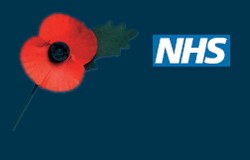
 Dr No observes Remembrance. Last Friday, the day before yesterday, at the eleventh hour on the eleventh day of the eleventh month, and this time as it happens of the eleventh year of the century, he fell silent and still for two minutes, and remembered those who have given their lives for the freedom we enjoy today. It is a moment of solemn awe for the sacrifice made, and of great humility in the face of such selflessness.
Remembrance was made that bit more poignant this year by the breaking news that Circle Health had signed the long foretold contract to run Hinchingbrooke Hospital. This contract is a clear challenge to the authority, competence and perhaps most of all to the values of the NHS; a challenge which, if not seen off, will in short order threaten the very life of the NHS.
For let us not forget: the NHS, with its high and burning ideals, was born during and of the Second World War. Those that fought in that war fought not just to annihilate the monstrous tyranny of Nazidom, but also to give way to a new order, the seeds of which were sown in the First World War, and in the years that followed, in which healthcare, based on need not ability to pay, would be available to all. The NHS is, as Dr No has said many times before, one of the crowning and defining achievements of post-war Britain.
Today, the NHS is under ferocious attack, in ways that it has never been before. There are those amongst us who openly decry it, and seeks its destruction, and replacement, not with a comprehensive national health service, but with a ad hoc patchwork of private providers funded not out of taxation, but from a rude assembly of commercial interests. These measures, if implemented, even if only in part, will in time destroy the NHS, and all that it stands for.
And so it is that Dr No feels the queasy irony that Remembrance Day this year was stained by the news that the first national health service general hospital is to be run by the private sector. For, to the extent that the NHS was born of the sacrifice of those who fought in the Second World War, any move that threatens to destroy the body and values of the NHS is, in its way, an affront to those who fought and died in that war.
By further irony, the house colour of Circle is red. We shall soon see that red cast on the NHS blue of Hinchingbrooke. Let us hope that in the years to come that Circle red does not bleed to become the red of a poppy, a red poppy of remembrance for the NHS we have lost.
I completely agree with you. In a day when we remember others’ sacrifices to preserve what we hold dear, we are seeing co-ordinated attacks on the legacy we had from their efforts – brought in by the three Bs – Butler, Beveridge and Bevan.
The Schools, Colleges and Universities are being decimated; the welfare state in under sustained pressure, and the NHS is being broken up.
That triumvirate of great men will see their consensus (Butler was a Tory, Beveridge a Liberal and Bevan a Socialist) being broken up by their successors – Cameron, Clegg and Miliband – political lightweights all.
What is happening is a reflection of the society we are becoming – selfish, greedy and parochial.
… because the comparison here is not fair. War kills, while the NHS saves.
A white poppy to remember those wasted by war and the agony felt by their loved ones because of their loss … and hopefully act as a reminder that we should all work towards ‘saving’ present and future generations from such horrors, just as the NHS does; save.
… and ‘saving’ is both; never forgotten and will never diminish, so worry not about the NHS Dr No.
What an interesting parallel – strongly agree with the sentiments of this piece.
Dear Dr No and JD,
The negotiations leading to Circle health taking over the Hinchinbrooke hospital started under a Labour government, indeed by Andy Burnham current shadow health secretary. There is a consensus accros all three English parties to increase the private sectors involvement across the NHS at least as strong as the consensus 60 years ago in favour of its formation. We are going to get it whether we want it or not.
Circle health is an interesting organisation, I was invited to a launch meeting some years,ago, and know some of the medical leads. It is a profit making organisation, but with an interesting ethos. The founders saw the changes that New Labour were bringing in, and wanted to have medical staff in critical roles rather than be the serfs of US corporations. I know how their ISTCs work, and they do have good productivity and a better track record than most ISTCs. If they cannot make a go of it in true blue Cambridgeshire then there is little hope that others would do better.
I see it as an interesting pilot and would want the professions interest to be in the rigorous and unbiased interpretation of the outcome. I did not join the circle group as I was not convinced by their business model and conditions of service, but am willing to watch with interest. It seems that staff will remain on existing nhs contracts and terms. If the management team fails, then there may need to be a rethink, but if it succeeds then good luck to them!
The key is in the evaluation and comparators and whether these are fair and unbiased. We should not let our own biases determine the outcome , but insist on some scientific rigour.
Dr Phil
Just that … it isn’t as bad as you think and may even turn out to be good too. So far, nothing to worry much about, because with change comes opportunity too. So, as Dr Phil said, let’s watch, wait and see.
I suspect an ISTC is much easier to operate than a hospital.
There should be no doubt about the number one consideration when drawing up a list of the key features to be evaluated and compared relating to a company floated on the stock market. It is profit. It has to be. All else must be a secondary consideration. Without profit, a company, in normal circumstances, would eventually cease to exist unless the government is determined to bale out unprofitable health care facilities at the eleventh hour just as they did the banks.
It will be difficult for a hospital run by a private company to make a profit out of patients unless they don’t treat as many patients as they are contracted for out of public funds. This happened with some ISTCs. Keeping patients in the community would therefore boost profits. Then they can cut staff. They could cut even more staff if they can identify the activities of dubious benefit that some people in the NHS are employed to do. The trouble is – much of this work is documentation and data collecting and generated by the Dept of Health itself and other institutions. Will private companies be freed from these obligatory activities in order to profit by cutting staff?
Then, of course, there is the Robin Hood approach. A private company, as well as their NHS funded component, could also embrace parts of public health, screening, alternative medicine, and those requiring short, sharp surgical procedures, cosmetic surgery and the ever popular enhancements with botulinum toxin, and make them pay for their services themselves or via separate insurance. Heavens, they could even cultivate a multitude of the worried well or narcissistic individuals for this very purpose. This may be what the financial investors and the government are relying upon. Surely this can’t be already happening???
The medical profession will become divided by this into those who encourage people to become the worried well / narcissists and those who don’t.
I realise all this is so obvious that a monkey could work it out, but My Black Cat was egging me on to comment because she wanted to leave this little fragment of a footprint in cyberspace for posterity to read when the NHS has become history.
“I suspect an ISTC is much easier to operate than a hospital” – providing they are properly equipped WD.
According to the torygraph in one case the ISTC “did not have enough swabs to stem the bleeding. Incredibly, it didn’t even hold any emergency blood stocks to replace the blood Dr Hubley had lost. The surgeons wanted to ring the local NHS hospital and ask for blood, but there wasn’t a phone in the operating theatre. Someone had to go outside and rummage around for his mobile. The blood took almost two hours to arrive in sufficient quantity. By that time, it was much too late.
http://www.telegraph.co.uk/news/politics/labour/6611887/The-doctor-who-died-as-a-result-of-Labours-ISTCs.html
I agree that it is much easier to run an istc than a DGH with maternity and casualty, particularly when tied to NHS terms and conditions. My understanding is that the same payment by results and targets apply as other hospitals.Clearly they intend to make a profit, and given the above I can see two principal opportunities. The first would be to increase productivity to the level of their ISTCs for elective procedures, the second would be to increase their provision of private sevices. This is an affluent part of the country with most of the existing private work going to cambridge. They may also wish to cut some loss making services.
I appreciate that some ISTCs have performed badly (the investigation of sheppton mallet found that their complication rate was no higher than other units) but Circle has a good reputation in this regard, and there are plenty of scandals about NHS hospitals under the old regieme.
All our parties have a consensus that this is the way to go, lets see how the pilot works. Profit is not incompatible with good care, as many general practices and care homes show. Indeed good care is an essental part of building the brand that a health care business requires.
I would be quite relaxed about seeing circle fail, after all I didnt invest, butif they make it work would be happy for their model to expand to other sites. The NHS needs to improve substantially to get to international standards of care, and provided the experiment is evaluated fairly have no objection to it.
Dr Phil
Sam and Boots – any more smugness from you two and Dr No will send the boys round…
Seriously though, this post was and is about what those who fought and still do fight in wars fought and fight for. Some of the fighting gristle, Dr No believes, comes from a wish to see a better world after the conflict. In the 1940s, part of that better world was the NHS. To dismantle that achievement after a few short decades does seem more than a little crass.
I did not mean to be smug, and apologise if that is how it came across.
I posted myself on Remembrance Sunday, prompted in part by a recent consultation with a homeless ex-soldier with post traumatic stress disorder, and major difficulties in coming to terms with what he had done and seen in Afghanistan, and my thoughts on how this contrasted with my own Grandfather’s reaction to similar experiences in the first war.
I alluded to how each generation has different values, and how what was right for my Grandfathers generation may seem wrong to us. He would be astonished at many of the things that we regard as right and just. We should not bind our children to our own desires and values, we must trust them and their decisions. That may include changes to many of the things that we hold dear, including health care. Not all change is for the worse.
Boots
“Sam and Boots – any more smugness from you two and Dr No will send the boys round…”
I bet your boys would love it here Dr No, they might even defect! Sooo, send at your own peril! … it’s 18c and the sun is right in the middle of the sky, and it will get warmer too as the day goes by soooo I’ve decided to stay a bit longer if only for the freebie vitamin A 😉
And, I’ve no idea what’s the matter with all of you medics on the web these days; sooo ‘not yourselves’!! Please read my lips ‘Nothing will happen to the NHS!’ … the bill was not fit for purpose and is now being fixed! … and when it is ready, it will be fit for purpose so, where is the problem?!
[Please don’t forget that I was perhaps the first one to highlight the bill’s inadequecies to start with, but I now acknowlege the huge amounts of work now being undertaken to make sure it is safe for patients … and staff, and if that means a bit more private sector involvement than the current misre 5%, then be it, I am no enemy of the private sector … and you never struck me as one either … before!]
“We should not bind our children to our own desires and values, we must trust them and their decisions. That may include changes to many of the things that we hold dear, including health care” – Lansley’s dogs dinner has got sweet FA to do with the desires and values of today’s generation, rather a desire to line the pockets of investment bankers like Ali Parsa.
The likes of Goldman Sachs screwed the American public (after the US banking collapse) and now they want to srew our health service.
Today’s values – have they changed since 1948?
http://www.youtube.com/watch?v=lqN3amj6AcE&feature=related
Perhaps Dr No will send Rosa Klebb instead…
Boots – Dr No saw your thoughtful, and anything but smug, Remembrance Sunday post, and he fully agrees that the plight of too many returning servicemen and women is a national disgrace. Perhaps those returning from the Second World War thought they were returning to a fairer society, in which the state would shoulder more responsibility for the provision, as well as funding, of healthcare – made all the more poignant here and now by the (strenuously denied) possibility that today’s returning service personnel may find not just a weakened NHS, but the prospect of being thrown back on Civvy Street even before they are back on their feet.
Dr No also agrees that ways and values change as the generations change, but at the same time he believes certain core values – and looking after the sick whatever their circumstances is the one he has in mind here – are eternal. That core value Dr No is sure we can all agree on. It is how that is best achieved that is up for grabs. Circle’s model somehow doesn’t cut the mustard.
Dear AndE charge nurse
I have a boss who is younger than me, and all the leading politicians in all three parties are younger than me. For the first time in my life in 2010 I had a prime minister and chancellor younger than me. I am closer to retirement than graduation, and closer to death than birth even if I live to be a hundred. There are Members of parliament born after I qualified as a doctor. My FY1 is too young to remember the Cold war. They are a different generation, a generation used to paying for higher education, and with a consumer rather than queueing ethos.
The baton has passed to the next generation, with different values and aspirations, let them run with it. The future belongs to them.
Dr Phil
Dear Dr No,
I fully agree that good quality health care should be free to all, but even very equal societies such as Sweden do this via extensive private provision. Indeed in most European countries this is the case. We do not have to ape America, but we should not be little Englanders who ignore how other advanced nations meet the same aspirations.
Boots
A and E Charge Nurse,
That was a scary article on the needless death of a patient in an ISTC a couple of years ago. Circle say they will be measuring things and, and hopefully their audit of patient experience will not be based on superficial questionnaires but will measure in a meaningful way deaths and morbidity during the hospital stay, deaths and morbidity after discharge, as well as readmissions, as all hospitals should be doing but probably don’t.
http://www.independent.co.uk/news/uk/home-news/banker-behind-private-hospital-revolution-pledges-patient-power-6262415.html
If you scroll down, FirstAdvisor, comments on this.
Dr Phil,
You sound as if you are in the process of putting yourself out to grass and positioning yourself for the history books. Please don’t hand over the baton. Let somebody pick it up off the floor after you’re dead! In that way your corner of the world will keep learning from your wisdom and your mistakes for many years yet, assuming you live to be 100!
We witches don’t hand over batons because we don’t have any. We remain part of the seething melée of life until the bitter end, putting in our tuppence worth when necessary and having the wisdom to stand back when that is necessary too. Everyone in society has a view, sometimes based on a great deal of experience and wisdom, sometimes not. When it is not based on experience and wisdom but on some kind of ideological vison then the view may still be right but is probably more likely to be catastrophically wrong. However, whether you are 5 or 95 years old, your views and your actions may turn out to be important.
Those who are ill and suffering are among the most vulnerable in our society. Your experience as an “ageing” Dr Phil counts when it comes to helping them. Patients’ experiences of the tribulations of being ill count even more. Sure, a banker, or a Japanese car manufacturer’s experiences will count too up to a point, but they should not be left holding a dangerously flaming imaginary baton!
“We witches don’t hand over batons because we don’t have any. We remain part of the seething melée of life until the bitter end, putting in our tuppence worth when necessary and having the wisdom to stand back when that is necessary too” – and how important this sort of thing is, not least because those with such experiences can remember today’s new, and exciting innovation first time round.
http://www.hsj.co.uk/news/internal-market-was-only-way-to-stop-thatcher-privatising-nhs/26572.article
How apt – the first owner of an NHS hospital is a former investment banker from goldman sachs, Thatch would have enjoyed that?
Talking of lessons from the past, and new generations, it strikes Dr No as possibly of some significance that the current zeal to allow part privatisation of the NHS arises some sixty five years after the start of the NHS. Those in power today, and indeed most of the population, have no memory at all of the pre-NHS days. He wonders whether the old saw about familiarity and contempt may be relevant…
A&E CN – the Glorious Irony of a ex-Goldman Sachs bonker taking over the running (not ownership – we must be careful not to overstate the matter) of an NHS hospital may prove all that is needed to knock the Alz out of Hacksaw! Now, there’s an alarming thought!
For the record, and while we are on Hacksaw, Dr No does not mistrust private provision (of funding mechanisms and services for vital national services – clearly private enterprise has a very important role to play in other sectors) per se, or for ideological reasons. Despite the ‘house colour’ of Bad Medicine being red, Dr No is not a closet red. Indeed he distrusts virulent ideology wherever it comes from; be it hectoring Thatcherism, BMA nannying on smoking in cars, or the Loony Left.
The reasons Dr No mistrusts private enterprise in the provision of vital national services are pragmatic and practical, and a key reason (but not the only one by any means) has to do with with the second word in the couplet. Enterprise itself is a compass that can point in any direction, from great social good, to the basest of greed. History, from the beneficence of Bourneville, to the stain of the Opium Wars, teaches us that. More recently, events in the financial markets have reminded us again what can all to easily come about when unbridled enterprise is unleashed and set upon the world.
The crux of the matter is the unbridled nature of enterprise – and it is no good saying it can be bridled – because then it would no longer be enterprise worthy of the name. Were it ever indeed to prove possible to, ahem, square that circle, then Dr No would no doubt find it far more difficult not to welcome Circle. But, human nature being what it is, the practical prospects for the bridling of enterprise do not look all that good. Once the hound of enterprise is unleashed, and the hunt for wealth is in in full cry, it is only a matter of time before the double-barrelled gun of profit and greed will backfire, and a lot of innocent bystanders will get badly hurt.
That is not in any way to say that public/state provision is perfect – clearly it is not. It is just that Dr No fears that as private provision increases, so too will the number of Mid Staffs scandals. It is, Dr No believes, as he has said before, the inevitable consequence of welcoming the third person – profit – into the marriage between patient and provider.
Boots – ‘Sweden…extensive private provision’? Not sure where that comes from. Dr No’s recollection was that the Swedes do indeed have good health outcomes, but on the back of high per capita expenditure in a largely publicly owned and run system. A quick google on the matter appears to confirm (see for example here, Table 9.1, from 2005, amongst many others) that is still the case (although he did come across an 2008 interview with what must be Scandinavia’s very own Mr Pasta here!).
Dear Dr No,
Perhaps my knowledge of Swedish Health care is rather Stockholm biased as Sweden has a very decentralised system, but 57% of primary health care in Stockholm is in the private sector, and 30% of the overall budget, with both geriatric and psychiatric services being contracted out to the private sector.
This is the link to the Stockholm County Council Annual report. This body is responsible both for the Swedish “NHS” and public transport. Look at the bottom of page 16: http://www.sll.se/upload/Budget/arsredovisn_2009engversion.pdf
It seems they have halved waiting lists whilst not increasing the % of GNP spent. Pretty good really. In Denmark if one has been on a waiting list for an operation for 2 months or more the State will pay a private contractor to do it and reimburse the private contractor. This has been in operation since 2002 without causing a collapse of the Danish “NHS”. We are not so different to our Scandanavian cousins, and many of the coalitions ideas have been tried there without meltdown. Perhaps our government is more europhile than it pretends to be!
Boots
It has been observed that Nordic languages are in fact English spoken backwards, such that when reversed back into English, they should make complete sense, but sadly something gets lost in the translation. Dr No struggled a bit to make sense of our Nordic colleagues report, but what he thinks he gleaned from the report (and a few other sources) is this:
The Swedish health service is run as a decentralised NHS. What this means is that there is a national service, but it is administered locally, by district, municipality etc.
It is mostly (around 97%) funded by social insurance, which (like our National Insurance) is more a tax than conventional insurance (levelled premiums/contributions (ie no risk based premium weighting/No claims bonuses etc), allied to (statutory) defined benefits).
The Swedes operate a purchaser provider split system, with a public body (akin to our PCTs) commissioning and purchasing care on behalf of their residents.
So – most of the funding comes from general taxation (using the term loosely to include national/social insurance payments), and most care is purchased/commissioned by a public body.
The purchased care is provided by a mix of public and private organisations. The mix depends on care setting. In secondary care (‘somatic’ and psychiatric) public provision accounts for between 83 and 87% of costs. Private providers account for 48% of geriatric care – but one wonders whether geriatric care also includes what we would call nursing homes. Dentistry remain largely (75%) in the public sector (perhaps Swedes with their natural good looks and fine bone structure don’t need so much botox), while 57% of primary care is provided by private providers. Overall, private providers consume just under one third (30%) of all healthcare spending.
On the face of it, this suggests a higher level of private provision in Sweden, but Dr No suspects this is a quirk of the way our Swedish colleagues have presented the data.
The percentage of private provision in conventional secondary care (‘somatic’ and psychiatry) is not that large (14-17%), although it is probably true to say this percentage appears more than equivalent NHS spend (a surprisingly difficult aggregate figure to find (or Dr No is being very thick) – this parliamentary answer (Feb 2011 – source here) suggests the comparable figure£100 billion – NHS England 2009/10 figures). However, that percentage is a total private spend out of a total budget spend, whereas the Swedish figure is a secondary care private spend out of all secondary care spend. If we were to correct for this (impossible to do accurately, given the figures available – we don’t know – or at least Dr No has not found the figures – how much of the £7.5 billion went on secondary care), we might well find that our comparable figure is indeed more – of for that matter less – than the Swedish figure.
The overall figure of 30% of money spent on private provision is heavily influenced by the spend in primary (57%), geriatric (48%) and other (wheelchairs etc – 65%)care services.
But how does that compare to our figures? If we consider GPs as private independent contractors, which indeed they are, then close to 100% of British primary care money goes to private providers. And if Swedish geriatric care includes, as Dr No suspects it does, money paid to private nursing homes, then again we have alao have a very high percentage NHS spend in the private sector (almost all nursing homes are now private sector). If we were to factor in these NHS spends as spend in the private sector, (including 35,000 FTE GPs on £100,000 (rounded figures, but it is still a corking – so corking Dr No wonders if he has made a ghastly mistake – £35 billion out of a total budget of around £100 billion…), then NHS percentage spend in the private sector is already way ahead of Swedish spend…
The reason for this, ahem, confusion is that the Swedes mostly present relative (proportion, percent) figures, and we all know what happens data is presented that way (before you know it, denominators can start slipping and shifting, and everyone ends up thoroughly confused).
The other interesting thing Dr No notes about the Swedish system is that it appears to be moving towards a state run managed care system – if he has read the report right. But then again, he might just have got the stick end of the wrong – which is what happens when you try to understand English spoken dackwards…
It’s not about you. It’s about people who died serving their country and remembering them. Don’t debase the occassion by using it as a day to air your own political views. There are 364 other days to do that. I doubt anyone on this page has ever worn uniform.