 Now that Dr No is out, he can write more freely of his past. Details he before kept back can now be brought forward, free of the anxiety of unintentional exposure. Indeed, this was one of a number of reasons why Dr No lifted the veil. He can now write of where he trained, the places he has worked, and the doctors, some outstanding and some rather less so, that he has known over the years; and of the capers and calamities that have lightened and darkened his career. For with a name comes the history. Anonymity, like virginity, once lost, is forever gone; that which was hidden has now become known. And – he might add, for those who detected a valedictory note in Dr No’s last post – let him assure them that, just as the ex-virgin rarely forsakes future carnal knowledge, so the ex-anonymous Dr No has no plans to forsake further appearances. Rather the opposite, in fact, but never, of course, to the extent of wanton promiscuity…
Earlier this week, the BBC screened a three-parter featuring the young James Herriot at Glasgow Veterinary College. Shot through a formaldehyde filter, the grey Glaswegian granite took on a cadaverous tint. The fumes penetrated, as they do, just about everything. A pet sheep got the vapours, and was put to its bed; elsewhere, a lame dray was put to sleep, only more finally. On the sets, paint peeled, and even some of the characters peeled, revealing layers of cattiness and bitchiness, not to mention vampiness, that quite out-catted, out-bitched and out-vamped the docile formaldehyde stunned animals. This wasn’t so much the usual Sunday evening Lark Rise fare, as Lark Fall. Viewers tuning in for some light-hearted sheep-diddling in the Yorkshire Dales were, it seems, sorely disappointed.
Dr No, on the other hand, was nostalgically reminded of his medical school days. Although he trained in London, starting in the late nineteen seventies, he was struck by how much the atmosphere of a nineteen thirties Glasgow veterinary college resembled the London medical school he came to know half a century later. He saw the same Edwardian décor, with its high glazed tiles on the walls and hand painted signage on the doors, and the long wooden laboratory benches strewn with the apparatus of chemistry and the inanimate remains of the once animate. All in all, Dr No suspects he would have felt more at home in that distant Glaswegian college than he would in one of today’s medical schools. Even the feminist sub-plot felt familiar: Dr No trained at the Royal Free, the first British hospital to allow women access to the wards to train and qualify as doctors.
The physical milieu was not the only familiar facet of the veterinary college. Dr No was reminded too of the cohesion and closeness that existed between students and, on occasions senior staff. A number of the staff were of course rozzers: one even threatened to sue the young Dr No for libel, over an article he had written in the student magazine. But it was one of the school’s professors, the stern but always brilliant and quite wonderful Ruth Bowden, who, on a matter of principle, came to the vulnerable young Dr No’s defence. The young student gave thanks by taking the great professor to dinner, at a bijou French restaurant in London’s West End – a stunt of such presumption that to this day he has no idea how he did it – but the great professor had already given the young student far more, something that would last long after the detailed anatomy of the peripheral nerves had faded: a nascent understanding of what it means to be a doctor.
By coincidence, also this week, Max Pemberton, writing in the Telegraph, picked up on a paper that describes how today’s caring and sharing medical school courses, which have displaced much of the traditional material students learnt, leave today’s young doctors feeling ill-prepared for the realities of serious illness on the wards. Dr No can’t help wondering whether, notwithstanding the wonders of caring and sharing excellence, the visceral hands-on training he received, and the gift of cohesion between a good teacher and a willing student, better prepares the student for the wards; for while an ability to care and share a patient’s pain may be good, knowing how to diagnose and treat that pain is even better; for that, above all else, is the essence of doctoring.
Happy Christmas Dr No,
I was at medical school at much the same time and we had very little formal training in communication and consultation skills. There was a need to bring this in, but what went out the window to allow the change of emphasis?
All the sympathetic pleasantries in the world will not help with a wrong diagnosis. It is something that I have been meaning to post on for some time. I think the rot in medical education that led to MTAS began with “Tommorows Doctors”, that was the key moment that the emphasis changed to educationalism rather than medicine. I had an interesting chat at the deanery recently with some colleagues about how in some specialities exam passes are higher for overseas graduates. It does help to have learned anatomy and pharmacology properly, it seems domestic graduates are often poor with these.
glad to have you back.
Dr Phil
Very much the same experience of some Prof. in my Med. School days.
The govt. did not know a good thing they had!
Boots – couldn’t agree more about ‘Tomorrow’s Daleks’, and have felt that way for some time. In fact, it was the subject of a very early (second ever, in fact) DN post, long before he had got into his proper stride.
It’s a truism that the medical curriculum is for practical purposes bounded and finite. Every time you shove something in, something else has to fall out. Sometimes Dr No suspects most medical educationalists (but definitely not all – there are some brilliant minds out there, but they shine out so because they are the exception) are in fact aliens, cunningly disguised to look like humans. They certainly speak an alien language that Dr No struggles to understand. Perhaps, come the New Year, Dr No will take a well-meaning pop at them!
In the meantime – a Very Happy Christmas to you too, and to everyone else!
Wishing you and your family a Merry Christmas young for always Dr No … I like the skirt 🙂
Merry Christmas Dr No and a very adventurous New Year!
Anna :o]
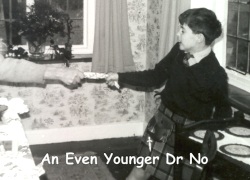
You’re out and I missed it! Drat! Anyone I know, Dr No, going by the kilt? Merry Christmas anyway..
It would be an odd small world if Dr No and his kilt had his origins in Coatbridge and was weaned on deep fried Mars Bars, wouldn’t it, My Black Cat?
Merry Christmas wherever you are!
In general practice I spend a not inconsiderable amount of time acting as interpreter for patients who have had their condition and treatment explained to them with all the skills Sir Lancelott Spratt cand bring forth, no doubt in front of a crowd of student doctors.
I don’t believe that there has ever been a time in which newly qualified doctors felt ‘unprepared for the realities of ill patients on the wards’. Only the responsibility that comes with qualification gives young doctors the confidence they need.
I also doubt very much that there is an ‘essence’ of good doctoring. In spite of the exponential rise in super-sub-micro-specialisms, the therapeutic relationship is an essential part of all doctoring, and this depends on mutual understanding as much as good clinical skills.
apols for the typos, … can bring forth & there has never been a time in which newly qualified doctors HAVE NOT felt ‘unprepared …
JT – I did wunder, and so gave the benefit of the doubt. We all do them.
But I also wunder about non-Sprats. Some of the worst ‘explanations’ I have ever heard have come from Shrinks – one famously launched into a PhD on the neuro-pharmacology of SSRIs in front of an increasingly baffled patient. But a key role for GPs is to translate – what Dr No once called, in another setting, reading the tea leaves.
Where I do disagree, perhaps, is over the essence of medicine. I think there is one; and yes, it probably has to do with trust.
I doubt we disagree about trust, the therapeutic relationship is a gift bestowed upon us because of trust. Even if we’re at the technical end of the specialist spectrum, patients need to know that we’re thoroughly competent with our expensive bits of kit & have their best interests at heart. If there is evidence that newly qualified docs felt better prepared on the wards as a result of more cadaver-disections & biochemisty and less communication skills & ethics, I’ll eat my stethoscope.
JT – we’ll have to hope it is a chocolate stethoscope!
Dr No was hopeless at biochemistry (the only cycling Krebs ever did for him was out of the window), physiology (although as a by-product he did learn about libel), and even worse at pharmacology, which he puts down to a Mad Greek Prof who delighted in failing summer viva candidates with a curt ‘come back when the leaves are brown’, which in a way demonstrated a form of communication skill, but not necessarily one to be practised on patients.
Anatomy was another matter. We probably both agree that part of the mystery of medicine is the laying on of hands. Somehow, the intimacy (and honour, because it is that) of being able to dissect a fellow human being gave Dr No an awareness of (and – at the risk of being ridiculed for absurd pomposity – communion with) the human body that simply could not be gained in any other way. When he later came to examine his patients, the laying on of hands held no taboo, because he already knew the body, quite literally inside and out. When he felt a liver or a spleen, he could visualise what he was feeling; and so this familiarity with the body, bestowed by anatomy, graced the laying on of hands, and so, in its way, enriched the non-verbal communication inherent in the laying on of hands. For, as any patient knows, how a doctor approaches and conducts the examination is central to the trust the patient feels in his or her doctor.