
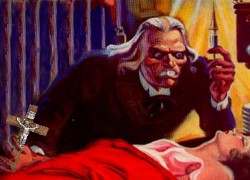
 Some time ago, the BBC ran a soap on the antics of ordinary yachting folk. Howards’ Way was, of course, pure video morphine, intended to induce coma and death in innocent Sunday evening viewers; and, in that strange way that fiction morphs into fact, we now have a new real-world version of Howard’s Way, where ordinary doctoring folk inject real morphine into real patients to induce real coma and death.
Dr No refers, of course, to the antics of one Dr Howard Martin, executioner-in-chief to those patients of his whom he deemed had failed his private Dignity Test. Fired up with ‘Christian Compassion’, the real Doc Martin shafted his patients with industrial volumes of lethal drugs in his zeal to assist their ‘passing over’. The fact that some of them were not terminally ill, and that others had not even been invited to consent, was neither here nor there. The Angel of the Lord had his work to do, and that was sufficient unto Doc Martin.
 Warning: post contains economics. Some readers may find themselves bored silly. In such cases, Dr No recommends taking a tea-break and returning to the post only when the sense of boredom has completely dissipated.
 Another voice has been added to the hue and cry for a minimum price for alcohol. Within days of Rubber Duck stepping down from his CMO post, the better to quack his favourite message, NICE, the National Institute for Health, Clinical and Anything Else Anybody Will Pay Us For Excellence, has jumped on the wagon. Voluminous guidance, published earlier this week, recommends a raft of measures that, NICE says, will ‘significantly decrease alcohol consumption’ if implemented. A top tip for government is to make alcohol ‘less affordable by introducing a minimum price per unit’. There was much talk of growing tides of unassailable evidence. Dr No began to fear he was now King Canute, alone on the beach, his once half full glass now half empty. Until, that is, he heard an interview on the Today programme. Suddenly the glass was half full again.
 Flogging toothpaste may be a dull business, but for once eyes must surely have shone brighter than teeth in the marketing department at Colgate this week. A gift of a study, published in the BMJ last Thursday, linked poor toothbrushing to heart disease. The media predictably flipped the message, with headlines certain to fix a smile on even the most jaded of Colgate lips. Auntie exhorted us to ‘Brush teeth to halt heart disease’, while the Daily Mail directed ‘Clean your teeth twice a day to keep a heart attack at bay’. The ping was at last back in the Colgate ring of confidence, for who needs advertising, when sparkling headlines (351 of them, according to google) say it all?
 The Hospital Manager’s Association
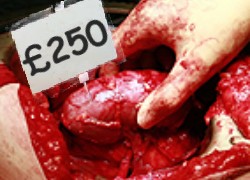 Jim Naughtie, interrupter-in-chief on Radio 4’s Today program, this morning scaled new heights of discourse interruptus, peppering a hapless Professor Dame Marilyn Strathern with tiresome ejaculations of febrile nuisance. One might presume that the Dame – who was until last year Mistress of Girton College, Cambridge - might be an expert in putting naughty boys in their place, but she was no match for Naughtie Jim.
 This week’s episode of Dr Who showed early promise, with khaki tea-making squaddie daleks, complete with Union Jack logos, but started to unravel the moment Ian McNeice started impersonating Robbie Coltrane, instead of playing Churchill, and descended into farce when the Lego-inspired bootylicious make-over daleks arrived. There was but one consolation: Bill Patterson, late of Sea of Souls, was finally revealed, as has long been suspected, as an alien.
 The origins of the phrase ‘balls-up’ are obscure. Some say that it arises from an awkward sexual encounter, but Dr No prefers a nautical origin. A vessel aground can be said after a fashion to be anchored, in that it is attached to the sea bed; and it is also unable to manoeuvre, or ‘not under command’, as the rules have it. A vessel at anchor carries one black ball, a vessel not under command two black balls, and thus a vessel that has run aground and is in trouble carries three black balls, a situation commonly and naturally referred to as a complete balls-up.
  There has been much ado about hospital death rates lately, much of it focused on the Mid Staffs hospitals, where consistently high apparent death rates were repeatedly brushed aside and ignored. The issue at stake was the validity - or not - of certain statistics produced by
  Sometimes Dr No has wacky ideas. One of his favourites is that all of time has already happened. Like a film in a can, it is all there, beginning to end; and, like a film, we see it sequentially, frame after frame, and that is what gives us the illusion of movement, and of the arrow of time. Sometimes he goes a little further; and, seeing the film strips lying in coils side by side on the reel, wonders whether we might, just might, if the conditions were right, be able to read the film not sequentially on the strip, but radially, on the axis of a spoke, and so be able to see, perhaps even move, backwards and forwards in time.